Subterranean termites require continuous soil moisture to survive, making the low-lying terrain near the Alafia River Basin and Bell Creek Nature Preserve an active nesting zone. Rapid residential expansion throughout…
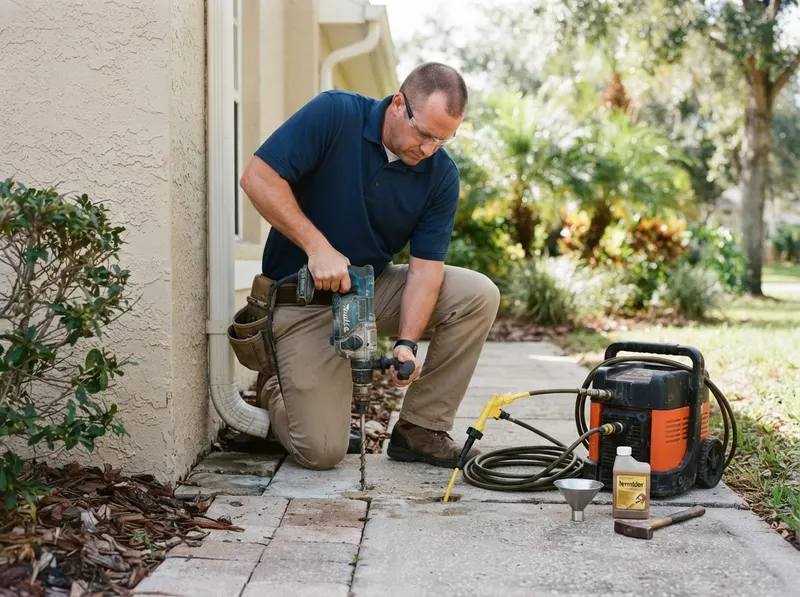
Subterranean termites require continuous soil moisture to survive, making the low-lying terrain near the Alafia River Basin and Bell Creek Nature Preserve an active nesting zone. Rapid residential expansion throughout South Fork, Triple Creek, and Summerfield Village frequently displaces undisturbed ground colonies. When developers clear pine flatwoods and grade damp pasture soils, subterranean termites naturally migrate toward the concrete slabs of newer homes. These insects exploit hair-line settlement cracks as narrow as 1/32 of an inch, utility conduit penetrations, and expansion joints to access wooden framing studs, baseboards, and roof trusses. A liquid non-repellent termiticide barrier applied directly against foundation footings bonds with the sandy loam soil, allowing foraging worker termites to transfer lethal active agents throughout the underground colony without detecting the perimeter boundary.
Deciding between liquid perimeter soil barriers and in-ground bait matrix systems depends on structural design and exterior landscaping. Properties in Panther Trace and Rivercrest featuring continuous concrete footers benefit from continuous trenching and rod injection, creating an unbroken chemical curtain that arrests structural access. Homes in FishHawk Ranch or Boyette Springs bordering heavy root zones, paver lanais, or extensive hardscaping often fit hex-pattern in-ground monitoring stations spaced every 10 to 15 feet around the drip line. Bait systems trade immediate soil saturation for low-disturbance colony elimination, using insect growth regulators that workers carry back to feed developing nymphs and the subterranean queen. Spot treatments serve exclusively as containment measures around active mud tubes; whole-structure perimeter defense remains the operational standard to prevent colony re-entry along untreated slab edges.
Subterranean termite control differs fundamentally from drywood termite treatments. Subterranean species nest underground and construct visible brown mud shelter tubes along stem walls and plumbing chases, whereas drywood termites live entirely inside dry structural timbers and produce distinct hexagonal fecal pellets. Structural fumigation tents drywood colonies inside the building frame but completely fails against subterranean colonies residing below ground level in moisture-rich soil. Field applications use non-volatile EPA-registered soil termiticides and tamper-resistant bait casings engineered specifically to remain stable in damp Florida soils without off-gassing into interior air spaces, keeping family living areas and domestic pets protected throughout the treatment process.
Every job gets a firm, written price after a free on-site visit.
Tell us about your subterranean termite treatment job in Riverview and we'll send a clear, written quote, usually the same day.
 Suncoast Heron Pest Control